LNEYA Industriekühler Hersteller Lieferant


battery charging test conditions at different ambient temperatures
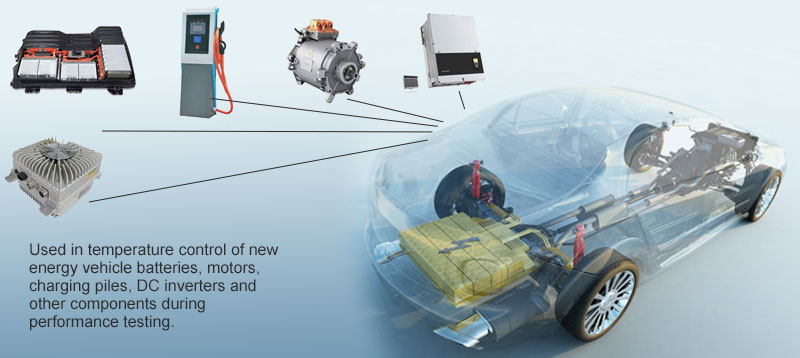
At present, the battery is undoubtedly the most core and critical component in electric vehicles. Therefore, both the OEM and the battery factory need to conduct a comprehensive test of the battery. The characteristics of automotive lithium-ion power batteries are greatly affected by ambient temperature. In low temperature environment, the available energy and power attenuation is more serious, because long-term charging in low temperature environment, the life will be greatly shortened.
In the case of -10 degrees, the battery capacity and operating voltage are significantly reduced; in the case of -20 degrees, the discharge capacity decreases sharply, and the specific capacity is only about 30% of that at normal temperature. Charging at low temperatures is also difficult. Metal lithium formed on the surface of the negative electrode is easy to accumulate. Further chemical reactions will cause internal short circuits in the battery, greatly reducing safety. In the measured temperature range, the internal resistance of the battery is higher under low temperature conditions, and the internal resistance becomes lower and lower as the temperature increases. The change of discharge energy is basically opposite to the change of internal resistance.
According to authoritative tests, the battery charging start current in hot cars is higher than cold cars, and the charging current is higher than cold cars, because the charging voltage is significantly higher than cold cars.
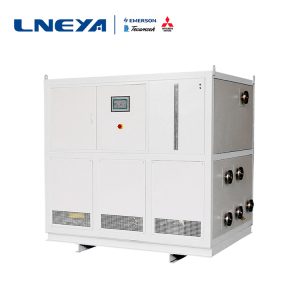
In these tests, the accuracy and temperature simulation become a very important factor. LNEYA’s KRY series-battery motor test cooling heating system is a product born for this emerging field. Fully enclosed tube design, high-efficiency plate heat exchanger, used for lifting temperature and constant temperature control in the test of new energy batteries and motors, especially suitable for heat dissipation and heat release process control during the test. With automatic fault protection function, it can output corresponding signals to ensure equipment safety. The main parts are international brands, quality assurance, the surface is treated with high-voltage electrostatic spraying, and auxiliary equipment can be added according to specific needs. It can achieve multi-channel temperature and flow control, one device can achieve multi-channel output, and each channel can control different flows without interfering with each other. Accepting customization requires solutions that control different flows and temperatures simultaneously.
Verwandte Empfehlungen
-
How to deal with the frosting of the chiller?
1891There are many types of chillers, and customers familiar with this piece are definitely familiar with the chiller. For the frosting of the chiller, many people are ignorant, and then let's learn more about it with LNEYA! 1. If it is a chiller, ple...
Details anzeigen -

How to install -50 °C cryogenic unit manufacturers equipment?
1766-50 °C cryogenic units are used in the refrigeration and chemical industry, so what issues should be paid attention to during installation? LNEYA professional manufacturers tell you that you should install according to the instruction manual. For...
Details anzeigen -
Heißer und kalter schneller Temperaturwechsel in der Prüfkammer gemeinsamer Fehler
1598In der Hochtemperaturprüfung der heißen und kalten schnellen Temperaturänderung Prüfkammer, sobald die Temperaturänderung nicht den Testtemperaturwert erreicht, in diesem Fall kann das elektrische System überprüft werden und die Fehler können auf...
Details anzeigen -
How to avoid incorrect operation of heating and cooling thermostat?
1477When the user is running the heating and cooling thermostat, the operation needs to follow the instructions, so how to avoid inappropriate operations? Excellent design of hot and cold thermostat: The LNEYA heating and cooling thermostat has a mul...
Details anzeigen