 LNEYA Industriekühler Hersteller Lieferant


New energy vehicle battery motor test motor oil chiller and liquid chiller
In the new energy industry, cooling methods mainly include natural cooling, air cooling, liquid cooling, and oil cooling. The cooling of new energy motors mainly includes oil cooling and liquid cooling. Then, these two cooling methods How are they all? Next, LNEYA a new energy motor oil cooler manufacturer, will give you a detailed introduction:
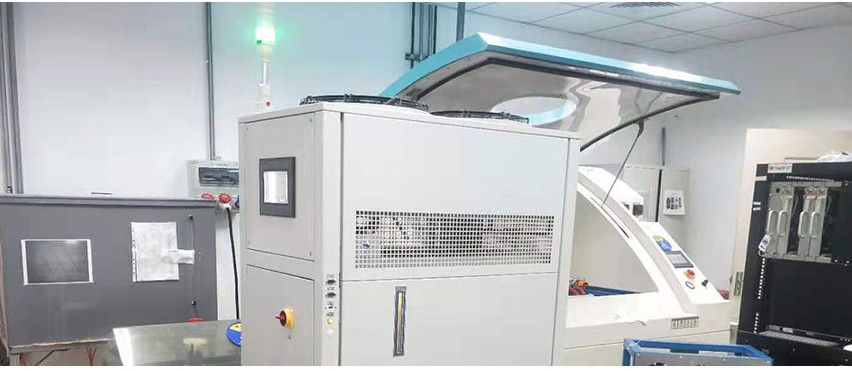
New energy motor oil cooling and liquid cooling applications:
- The new energy motor oil cooler is mainly used in hybrid vehicles, because hybrid vehicles need to consider the cooling of the internal combustion engine and the motor at the same time, so it is more appropriate to use oil cooling. The cooling method of the new energy motor oil cooler is to pump the oil into the oil pipe through the oil pump. The oil pipe installed inside is perforated, and the oil is sprayed inside the motor to achieve the dual functions of cooling and lubrication.
- New energy liquid coolers are mainly used in pure electric vehicles, because liquid cooling can more effectively remove the heat from the motor and prevent the motor from overheating. The liquid cooling method is basically the same as the liquid cooling method of the engine. The coolant is provided with water channels inside the casing, and the stator is installed in the casing. The coolant does not directly contact the stator, and dissipates heat in the form of heat conduction.
How to choose between oil cooling and liquid cooling for new energy motors:
- As for which is better, oil cooling or liquid cooling, it actually depends on the specific usage scenarios and needs. The cooling effect of the new energy motor oil cooler is slightly worse than that of liquid cooling, but in some special cases, such as high altitude or cold environment, the cooling effect of the new energy motor oil cooler will be more stable. The cooling effect of the new energy liquid cooler is better, but in the environment of large temperature difference, the liquid cooling may produce some condensed water, so it is necessary to pay attention to prevent the motor from getting wet.
- As for whether the pure electric vehicle motor is cooled with oil, this is possible, but relatively rare. Because the motor of a pure electric vehicle is mainly driven by electricity, it is more necessary to consider the efficiency and service life of the motor, and the choice of the cooling method of the new energy motor oil cooler is more determined according to the specific model and usage scenario.
7 * 24 kostenlose Beratung und umfassende Lösungen anbieten


E-Mail: sales@cnzlj.com
WhatsApp: 086 13912479193
Verwandte Empfehlungen
-

Beschreibung des Stromverbrauchs in der Großkälteanlage LNEYA
1968In the process of operation, the cooling capacity and working conditions will affect the power consumption of the entire large refrigeration unit, but in order to avoid unnecessary power consumption, we need to understand the other power consumpti...
Details anzeigen -
Relationship Between Condensation Temperature And Condensation Temperature In Ultra Low Temperature
1937The chilling temperature of the ultra low temperature recirculating chillers refers to the temperature at which the state of the substance changes from a gaseous state to a liquid state under a certain pressure. Different substances have different...
Details anzeigen -
How to choose laser chiller?
1952The term laser is an acronym for light amplification by stimulated radiation. When the electrons in the atoms of optical materials (such as glass, crystal or gas) absorb the energy of the current, a laser is generated. The increased energy excite...
Details anzeigen -
What is the reason why the industrial chiller system cannot be cooled
1898Let the LNEYA technical engineer explainthe reason for everyone: The first one: The chiller system fails tolower the temperature during the first use, or there is a problem with theinstallation of the industrial water chiller, cooling tower, ...
Details anzeigen



Zur Konsultation einreichen
Wir werden Ihnen innerhalb von 24 Stunden antworten