LNEYA Industriekühler Hersteller Lieferant


The solution to the fully enclosed heating and cooling thermostat lack of refrigerant alarm
What should I do if the fully enclosed heating and cooling thermostat alarms for lack of refrigerant? I believe that many customers will encounter this problem when they use it. In fact, this is relatively simple. As long as we know the principle of the lack of refrigerant alarm, it can be solved very well. Today I will share two points with you so that everyone will encounter this problem. It can be solved very quickly.
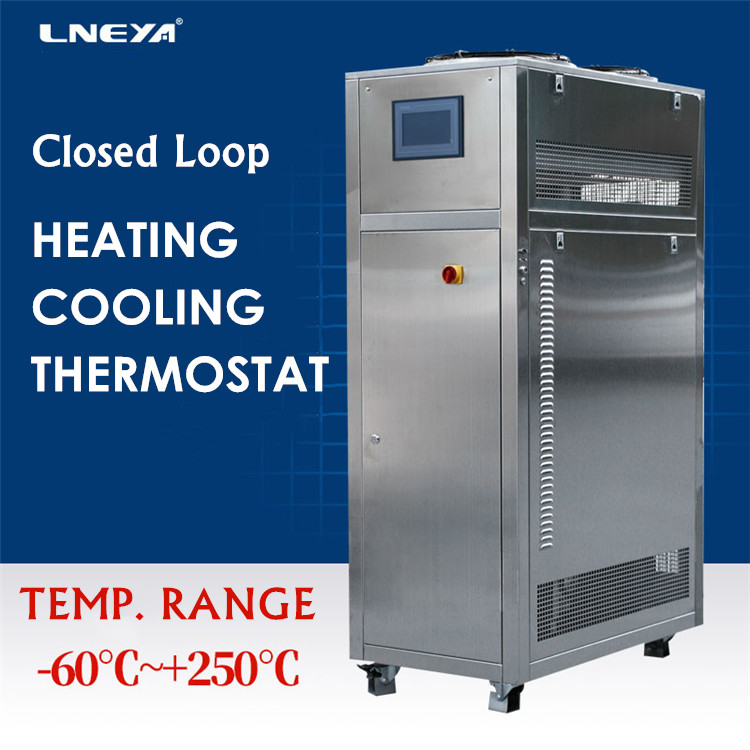
When we encounter a refrigerant shortage alarm in a fully enclosed heating and cooling thermostat, the first thing we have to do is to check to see if the liquid level on the expansion tank of the fully enclosed heating and cooling thermostat is at the normal level, if it expands at this time The liquid level of the fuel tank is lower than the low level, then this alarm is caused by the lack of oil in the system. What we need to do is to add new heat transfer oil in time until the system has a stable pressure and the liquid level of the expansion tank is at the normal level. It can be solved.
There is another situation that will also cause the fully enclosed heating and cooling thermostat to alarm for lack of refrigerant. That is, an alarm occurs after a period of use. At this time, we also need to check the liquid level of the expansion tank. If the heat transfer oil is lower than the low level, there must be a leak in the pipeline, which needs to be found and repaired in time. If it is not the leakage problem, then Most of it should be that the liquid level float switch of the expansion oil tank touches the wall of the expansion oil tank, causing the liquid level switch to not work normally. At this time, we need to remove the liquid level switch and re-reinforce it. The main reason for this situation may be due to The fully enclosed heating and cooling thermostat is caused by slight vibration during use.
The above are two solutions for the lack of refrigerant alarm. The alarm is a fully enclosed heating and cooling thermostat’s built-in protection, mainly to prevent the heating tube from burning dry, so when we encounter this problem, we can solve it in most cases according to the two methods shared by the editor. If it is solved No way to contact LNEYA after-sales technical support.
Verwandte Empfehlungen
-

Prüfanweisungen für die Kälte-Heizungs-Temperaturregelanlage für die Heizölprüfung
1840The refrigeration heating temperature control system can be tested for different projects during operation. The detection of different projects is different. Among them, the refrigeration heating temperature control system for fuel oil testing is ...
Details anzeigen -
Umgang mit dem Störungsalarm der Rückkühleinrichtung
1441Was ist zu tun, wenn während des Betriebs der Rückkühleranlage eine Störung und ein Alarm auftritt? Um die Produktion zu gewährleisten, müssen solche Probleme schnell behoben werden. Wir müssen zunächst die Ursachen von Ausfällen und Alarmen verstehen und verschiedene...
Details anzeigen -
Introduction To The Use Of Explosion-Proof Precision Chiller
1698Wuxi Lneya solves the problem of how to charge refrigerants in the absence of refrigeration. 1. Connect all kinds of equipment well, close the three valve when the vacuum pressure is down to 133.3Pa, remove the hose from the suction port of the va...
Details anzeigen -
Closed Refrigeration Heating Circulator Daily Maintenance Manual
2128The closed refrigeration and heating circulators of different manufacturers have a certain life span. Reasonable and correct operation and maintenance of the closed refrigeration heating circulator can effectively extend the service life. The user...
Details anzeigen