LNEYA Industriekühler Hersteller Lieferant


Wie wird die Batterie beeinflusst, wenn das Brennstoffzellenfahrzeug bei niedrigen Temperaturen kalt startet?
At present, the topic of fuel cell vehicles in China is relatively hot. Fuel cell vehicles have the advantages of large market space, high technological status, short hydrogenation time, high battery life, and low pollution.
However, at present, fuel cell vehicles are in the embryonic stage of the industry, and there are still some obstacles in terms of infrastructure, cost, storage and transportation, and technology, which has caused the price of hydrogen fuel cell vehicles to remain high.
Today, look at why fuel cell vehicles are affected by cold start of hydrogen fuel cell vehicles.
No1: Low temperature cold start is one of the main factors affecting the commercialization of fuel cell vehicles
If the fuel cell operates at a continuously low or high temperature, there may be a safety risk. Especially in the colder areas of the north, the use will be limited.
Although with the advancement of technology, the current low-temperature and high-temperature working environment can already be solved by adding heating modules and heat dissipation systems, but the cold start of the fuel cell vehicle at low temperature still requires a relatively long time. Obviously, the low temperature cold start takes a long time is one of the technical problems facing fuel cell vehicles.
No2: Low temperature cold start is related to the structure of the fuel cell
The structure of a fuel cell vehicle is mainly composed of a driving motor, a power battery, a fuel cell system, and a vehicle controller. The main function of the fuel cell system is to convert hydrogen gas into electrical energy through an electrochemical reaction to charge the power battery and drive the motor. It is a very important part of fuel cell vehicles.
At present, most fuel cell vehicles on the market use proton exchange membrane fuel cells. Proton exchange membrane fuel cells (PEMFC) have various performance advantages, including low battery operating temperature (<100℃) and fast starting speed. At the same time, It is widely used in transportation and mobility, so the global shipments of proton exchange membrane fuel cells dominate.
However, the proton exchange membrane fuel cell (PEMFC) car also has a relatively big disadvantage when operating in a low temperature environment, that is, the cold start takes a long time.
No3: Low temperature reduces fuel cell performance, resulting in difficulty in cold start
Low temperature cold start means that the fuel cell vehicle can be successfully started at a temperature below 0°C, and can quickly raise the internal temperature of the fuel cell to 70~80°C to meet the performance of normal operation.
In the working environment without special protection and at 0 ℃, the water generated by the electrochemical reaction of the fuel cell is easily frozen to cause the catalyst layer and the diffusion layer to block, which hinders the progress of the electrochemical reaction, and the volume change caused by the freezing of water will also The internal structure of the fuel cell causes damage, resulting in a decrease in fuel cell performance.
Look at the fuel cell bus’s cold start experiment process at -30℃ low temperature environment. The vehicle is continuously frozen in the -30℃ environment for more than 20 hours. During the period, the vehicle is powered on to collect the temperature of the fuel cell and power battery, and record the temperature of the two. Decline the curve to evaluate the effect of the battery compartment warming measures; when the temperature of the fuel cell is ≤-20°C and the temperature of the power battery ≤-25°C, it is judged that the freezing stops.
The relevant conclusions of the experiment are as follows:
(1) The fuel cell can be successfully started in 15 minutes after freezing in a -30℃ environment for more than 20 hours;
(2) After the vehicle-mounted hydrogen system is frozen at -30℃ for more than 20 hours, there is no leakage at all pipeline connections.
In the field of hydrogen fuel cell vehicle research and development, Japanese car companies and Korean car companies are at the forefront, and mass production of hydrogen fuel cell vehicles has been achieved in passenger cars. Domestically produced hydrogen fuel cell vehicles are still based on passenger cars and special vehicles. the Lord.
Therefore, in the production process of hydrogen fuel cells, manufacturers must indispensable in order to ensure performance
To use the performance at different temperatures, after all, it is impossible for the battery to completely rely on its own heating and cooling cycle components to adjust the obstacles generated during use.
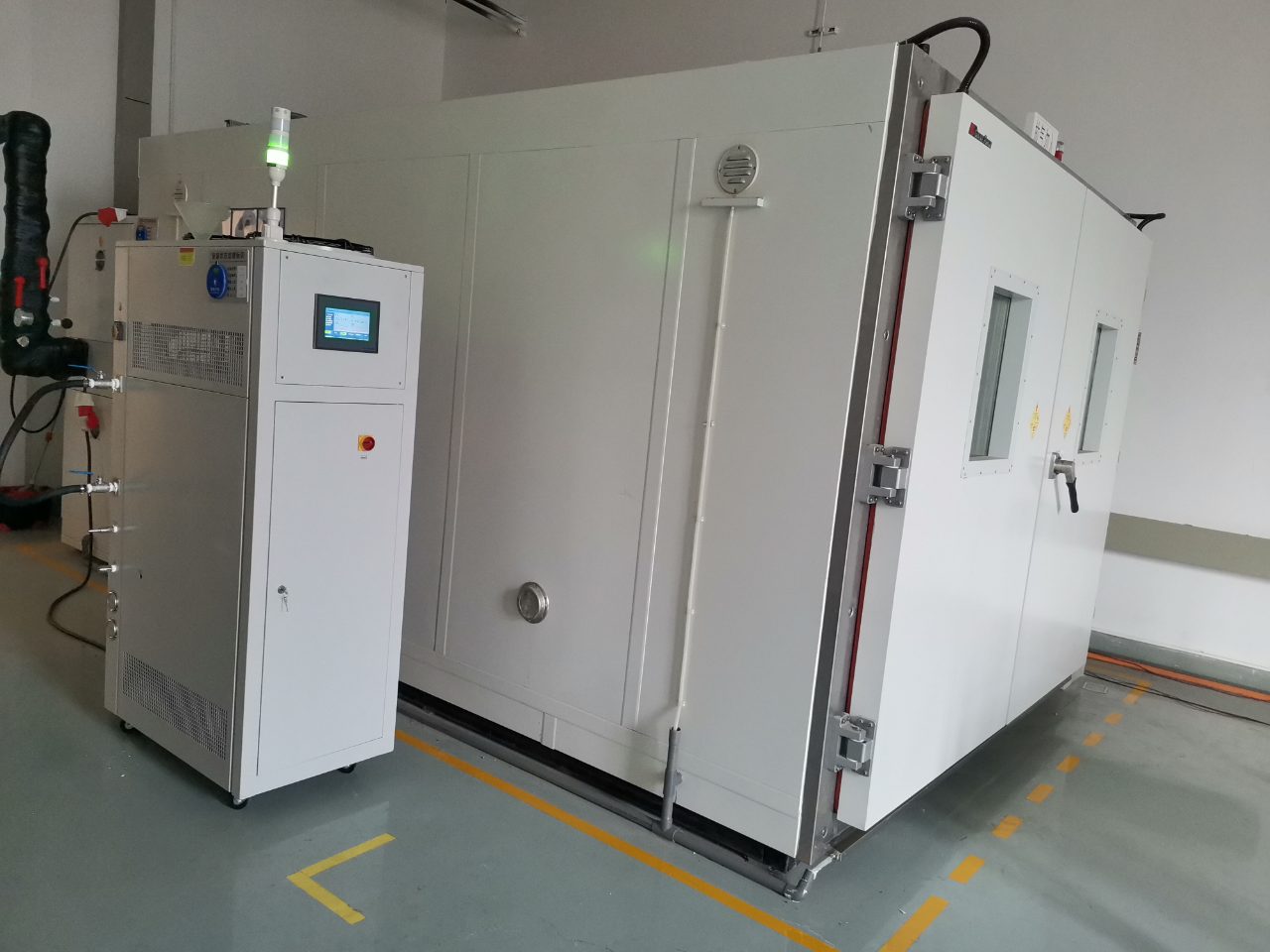
LNEYA KRY series electric vehicle battery motor test chiller for power battery charging management, used to test permanent magnet synchronous motor, switched reluctance motor, asynchronous motor and its precision temperature control device can be achieved through the LCD control panel + Remote control mode; with automatic fault protection function, it can output corresponding signals to ensure equipment safety. The main components are international brands, quality assurance, the surface is treated with high-voltage electrostatic spraying, and auxiliary equipment can be added according to specific needs. The test control temperature range is -40℃~+100℃, and the temperature control accuracy is ±0.5℃. The device can control the flow separately or individually, and it needs to control different solutions at the same time (customized).
Verwandte Empfehlungen
-

LED LCD display thermal test system operation process
1536The integrated semiconductor industry has developed rapidly in the past two years, which has driven other industries around it. The chip thermal test system is one of the products. In order to avoid machine failures in the LED liquid crystal displ...
Details anzeigen -
Das Kälteprinzip des Glykol-Kältesystems
1664Manchmal muss der Kälteträger eine Temperatur unter 0 C erreichen. Wenn das Eis den Koch trägt, friert er ein, so dass die Zugabe von Gefrierschutzflüssigkeit das Einfrieren verhindern kann, und Glykol kann das Einfrieren verhindern. glycol chillers ,
Details anzeigen -
From what aspects should we consider the use of circulating coolers?
1402Circulating coolers are a popular choice for temperature-critical applications because they provide stable temperature control, constant flow and constant pressure control. Many process heating systems require cooling and heating. For example, man...
Details anzeigen -
What are the main hazards of the reaction kettle in the reactor intelligent temperature control syst
1736The intelligent temperature control system of the reactor is used in various chemical fines. With the constant attention of the industry safety issues, some risk factors of the intelligent temperature control system of the reactor should be avoide...
Details anzeigen