LNEYA Industriekühler Hersteller Lieferant


Das Kühlkreislaufsystem dient zum Auffangen des nicht kondensierbaren Abgases in der Destillation s
Most rectification towers are two-stage condensation. The first stage uses cooling water, mainly condensing the top steam, and the second stage uses chilled water or ethylene glycol, which is mainly used to treat tail gas and remove a small amount of light components. The exhaust gas is condensed. Therefore, the secondary condensation is very small.
Generally, a rectification tower (especially in the case of non-condensable gas, such as a vacuum tower, an atmospheric tower with gas dissolved in the feed, etc.), a two-stage condenser is placed on the top of the tower, and the first stage is cooled by cooling water. Part of the top steam is condensed, and the second stage adopts chilled water cooling to condense the light components in the tail gas as much as possible to reduce material loss. The reason for this is that the operating cost of chilled water is much greater than that of circulating chilled water, so it can be used as little as possible. The primary cooler uses cooling water to condense most of the easily condensable media, and the secondary cooler uses chilled water to condense the remaining small part of the exhaust gas that is not easy to condense. This can reduce the use of chilled water and save energy.
Distillation device, the device is divided into two stages of distillation, the first stage distillation condenser uses cooling water for condensation, while the second stage uses chilled water for condensation. The first stage adopts cooling water cooling to condense most of the top steam, and the second stage adopts chilled water cooling to recover the light components in the tail gas as much as possible to reduce material loss. The light components of the two stages are the same, but the amount of steam from the top of the second stage is smaller than that of the first stage. What is the difference between using chilled water to condense and chilled water to condense? Why do the primary and secondary condensers use different cold media for condensation?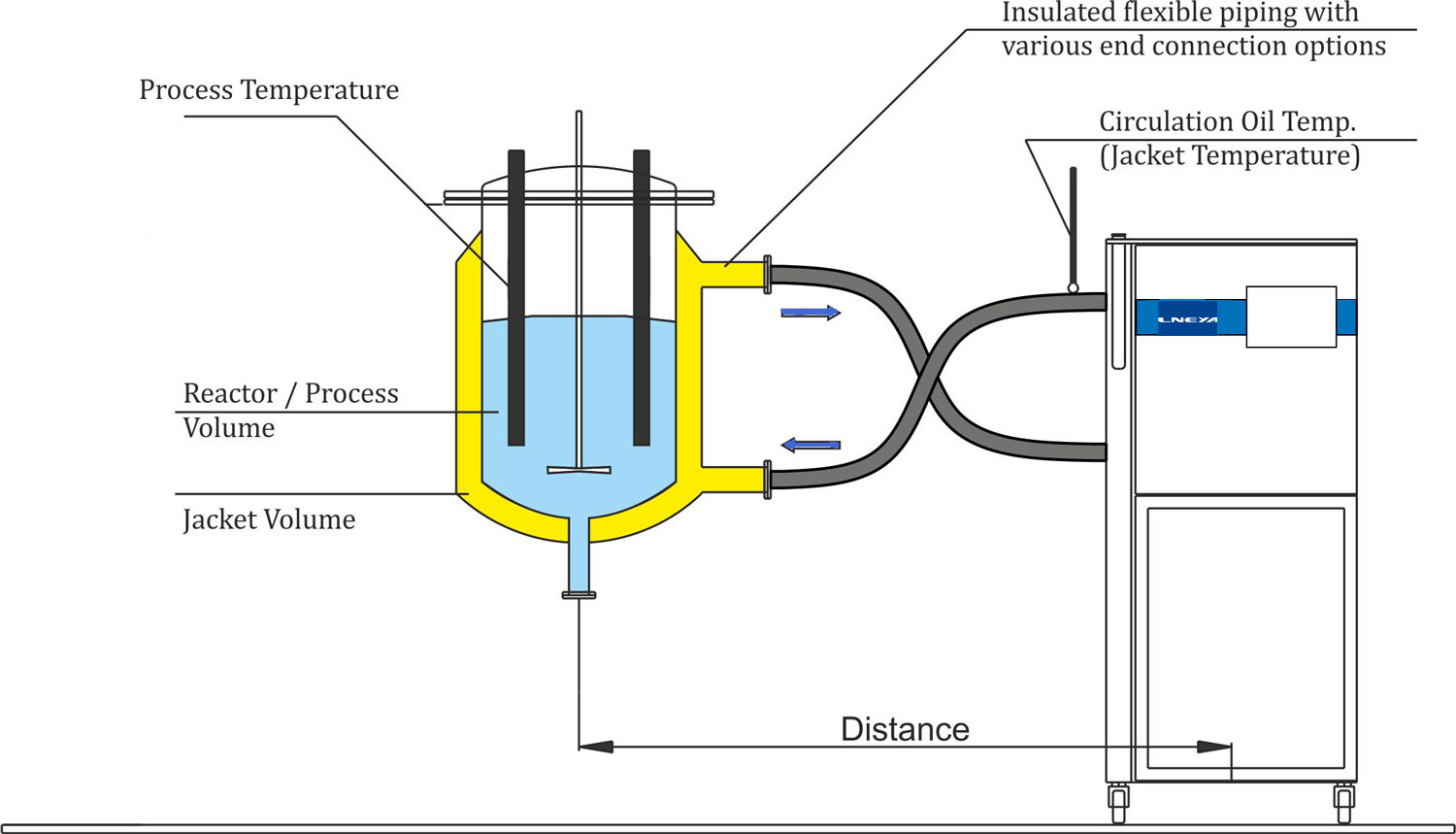
Cooling water is circulating water, the temperature is generally 32-40 degrees. Low cost, easy to use, economical. Chilled water is low-temperature water produced by a low-temperature system. The temperature is generally below 20 degrees, and there are many grades to choose from. Chilled brine is relatively expensive, so the primary cooling will condense a lot of steam, and the secondary will condense the remaining steam.
For the recovery of non-condensable tail gas components in the distillation system, cooling water and chilled water are indispensable, but this also invisibly increases the consumption of resources. The role of one or more water cooling systems is particularly important. The LNEYA cooling cycle system adopts secondary subcooling, which has a fast cooling speed, safe and reliable, and is used for rapid liquid cooling. It is widely used in petrochemical, medical, pharmaceutical, biochemical, freeze-drying, pharmaceutical, military and other high-tech industries. In order to save water resources, ethylene glycol-water mixture can be used for circulating refrigeration, and the circulation pipeline design is strictly designed to prevent circulating water pollution and extend the use time of circulating water.
Verwandte Empfehlungen
-
Wie wählt man Kältemaschine und Spritzgießmaschine aus?
1683A. First way:The 1HP water-cooled chiller can be equipped with 80 tons locking force injection moulding machine, and the temperature can be controlled at 5-10 degrees.The 1HP water-cooled chiller can be equipped with 100 tons mould-locking force i...
Details anzeigen -

The use and characteristics of the SUNDI series of high and low temperature cooling circulators
1801The SUNDI series of high and low temperature cooling circulators are equipment for direct or auxiliary heating in the fields of biology, physics, chemical engineering, medical treatment, environmental protection, etc. Moreover, the temperature con...
Details anzeigen -
Ultra-Tiefkühltruhe DW von LNEYA
2428Ultra Low Temp Freezer DW Beschreibung: Ultra-Niedrig-Temperatur-Gefrierschrank hauptsächlich für die wissenschaftliche Forschung, spezielle Materialien der Niedrig-Temperatur-Test und Erhaltung; Einfrieren von roten Blutkörperchen, weißen Blutkörperchen, Haut, Bakterien, Sperma, biologische...
Details anzeigen -
Explosionsgeschützter Ultratiefkühlschrank - Anweisungen für interne Leckagen
18281. Sound leak detection method: First, the refrigeration pipeline of the explosion-proof ultra-low temperature refrigerator is filled with nitrogen. Then use a stethoscope to check the interior. When you hear a leak in a certain area, mark it. Car...
Details anzeigen