LNEYA Industriekühler Hersteller Lieferant


Wartungsmethode für ein Ultra-Niedrigtemperatur-Kühlsystem (Kältesystem)
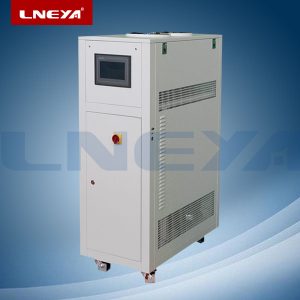
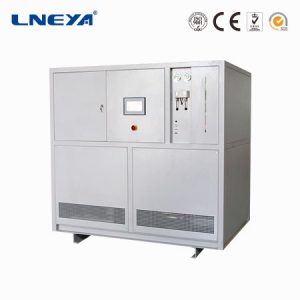
Die ultra low temp chiller refers to the refrigeration unit whose chilled water temperature reaches below minus 35℃. The unit adopts two-stage compression refrigeration, and the combination of the scroll compressor and the piston compressor is used to manufacture a freezing source of minus 35℃ or even minus 60 ℃, to meet the requirements of the production process, to ensure the normal and smooth production.
Firstly, the leak detection of ultra low temp chiller system.
1. The refrigerant side of the unit has undergone a strict leak detection process during the factory and commissioning process.
2. After the unit is running, check the high-pressure part with the leak detector to ensure the tightness of all connections.
3. If a leak is found, it should be disposed of immediately. In general, the connection of the nano or flange bolts can be used to eliminate the leaks, but there is also the possibility that the refrigerant be recovered and then the leaks must be treated. Such as the leakage of welded joints.
Second, the system’s pressure leak detection.
The standard pressure leak detection steps for ultra low temp chillers are as follows:
1. Fill a small amount of R-22 gas to a system pressure of 2PSIG.
2. Fill the system with nitrogen to 25~50 PSIG. Make sure the pressure reaches all parts of the system. The oil valve can be opened slightly, and the leak detector is used to check whether there is refrigerant.
3. Check each joint and weld, and try to be careful and spend as much time as possible. The leak detection equipment used must be sensitive and reliable.
4. Open the top bleed valve of the evaporator and condenser to confirm that no refrigerant has been detected. If refrigerant is found, the end cap should be removed to remove the internal leak.
5. Confirm that the system is completely sealed, and the gas is released from the system at an appropriate flow rate from the filling valve to perform a certain purging action.
Thirdly, vacuuming and drying of ultra-low temperature chiller system.
1. Connect the high efficiency vacuum pump and the mercury vacuum gauge in series with the filling valve of the system.
2. Open all valves of the system that connect the valve, the suction valve and the vacuum gauge. Confirm that all valves that pass through the atmosphere are closed.
3. Start the vacuum pump and pump the vacuum to 5mmHg.
4. If there are conditions, 50oC of hot water can be introduced into the system to accelerate the evaporation of the system’s memory and improve the dryness.
Verwandte Empfehlungen
-

Application and advantages of new energy automotive motor test equipment
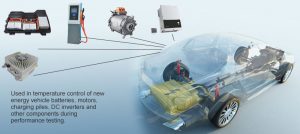
1541LNEYA's new energy motor test equipment is used in HEV (Hybrid Electric Vehicle), BEV (Electric Vehicle), Hydrogen Power Vehicle, Fuel Cell Electric Vehicle, EREV (Extended Range Electric Vehicle) and other new energy vehicles. LNEYA's equipment a...
Details anzeigen -
Hoch- und Niedertemperatur-Heiß- und Kaltwasserkühlmaschine für den Test von Batteriemotoren
1631LNEYA Hoch- und Niedertemperatur-Kalt- und Warmwasserkühler werden für das Wärmemanagement der Batterie von Elektrofahrzeugen mit neuer Energie verwendet. Das folgende ist das relevante Prinzip im Wärmemanagement angewendet.die hohe und niedrige Temperatur kalt und...
Details anzeigen -
Merkmale und Vorteile von luftgekühlten Kaltwassersätzen
16541. Configuration of air-cooled chillerAir cooled chillers can be divided into air-cooled vortex chillers and air-cooled screw chillers according to the type of compressor. The air-cooled vortex chiller is mainly composed of vortex compressor, evap...
Details anzeigen -
battery charging test conditions at different ambient temperatures
1991At present, the battery is undoubtedly the most core and critical component in electric vehicles. Therefore, both the OEM and the battery factory need to conduct a comprehensive test of the battery. The characteristics of automotive lithium-ion po...
Details anzeigen